Providing a platform for my written work.

Being and Place is an interdisciplinary research project which spans a number of subject areas a view to uniting the two great wings of moral, philosophical, and scientific thought: contemplation and action, objectivity and subjectivity, theoretical reason (the realm of science, fact) and practical reason (the realm of politics, ethics, artifice, will, visions, and values). Being and Place weaves the various subject disciplines into a coherent worldview in an attempt to counteract the baneful effects of academic specialisation and metaphysical fragmentation.
Rationale
I established the Being and Place project in 2006 with a view to developing an integral philosophy for living. I combine extensive research and intensive reading across the various subject disciplines. The approach is founded on a deep interdisciplinarity, ranging widely whilst weaving specialist knowledge through its interconnection. I have specialist knowledge in the fields of philosophy, history, economics, ethics, ecology, the urban environment, literature, and theology. Seeing the world as an interconnected whole, I weave materials from all of these disciplines together to form one coherent whole. The result is an integral approach to a multidimensional reality.
Being and Place was designed with the express purpose of building bridges between the scientific, social, and cultural disciplines, integrating materials holistically without losing specialist depth. Without specific details, the whole is vacuous; without relation to the whole, the details are inert and incomplete. Combining breadth and depth, the approach seeks to counteract the increasing fragmentation of knowledge in the contemporary world by way of integration within a coherent and – one hopes – cogent worldview. Thinking beyond the boundaries, the hope of the integral vision presented by Being and Place is to inspire an action that is attuned to the links and connections comprising the one world within which we all dwell. The end goal is a truly human society of human beings rooted and settled in a place they can call their own, a being and place that counteracts the inhumanism and displacement that is now upon us.
The scope of the research is extensive but the idea is clear and concerns the connection between being and place, the moral meaning that human beings invest in the world around them as the rational evolution of the human ontology. The central theme is that of cities, citizenship, and civilisation as the mutual unfolding of nature within and nature without, affirming the unity of human beings in society and of society and nature. The research examines philosophical conceptions of freedom, security, reason and power from classical origins to the present day in order to define the public realm as the appropriate habitat for human self-realisation. The research incorporates evolutionary biology, psychology, anthropology and ecology within a socio-philosophical perspective in order to make the progress of rationalisation responsible to moral values and conscious social control.
Books
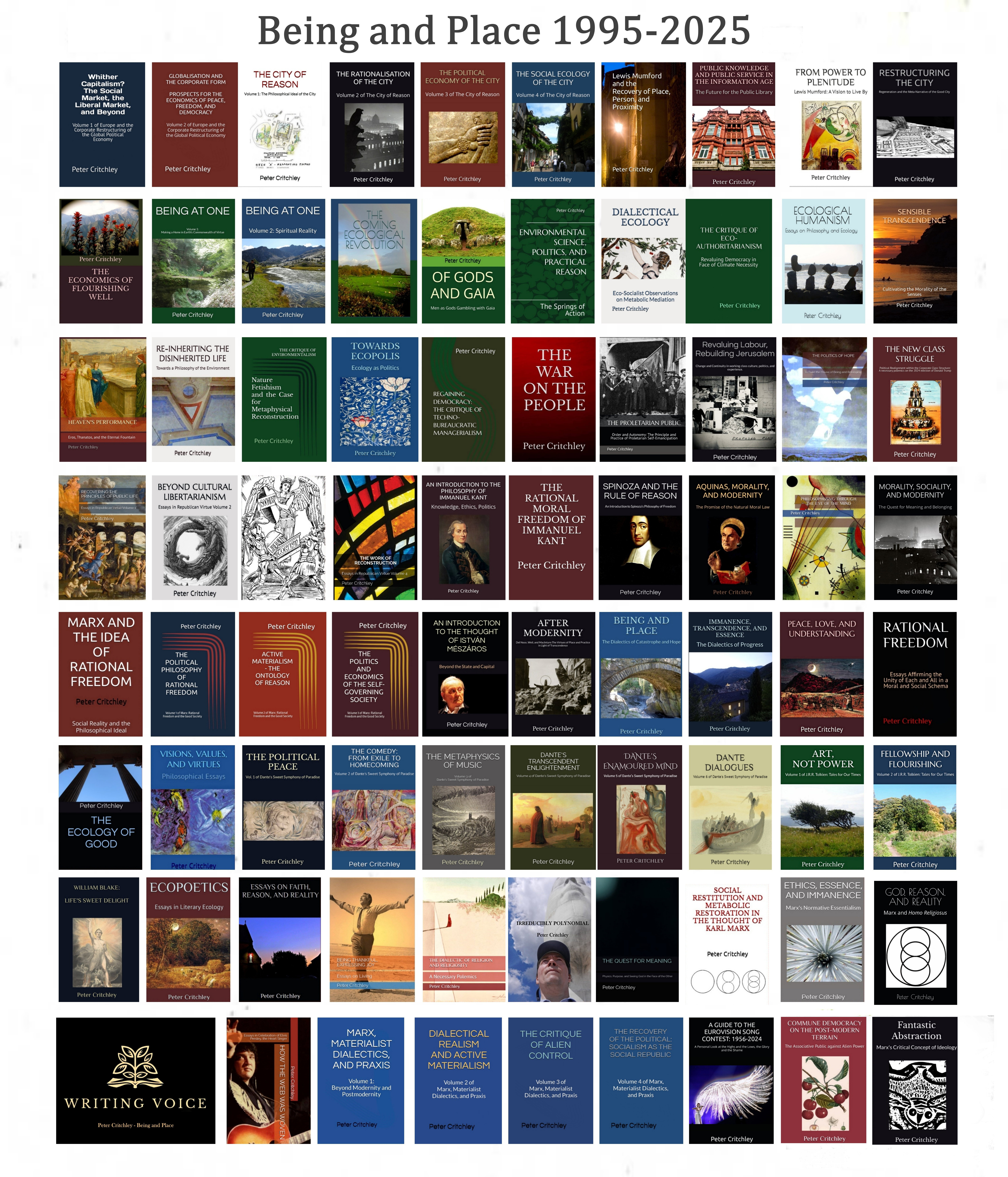
My Books: 1995-2025
Details in the links below the descriptions.
ECONOMICS
Europe and the Corporate Restructuring of the Global Political Economy: Volume 1: Whither Capitalism? The Social Market, the Liberal Market, and Beyond. 1995.
Europe and the Corporate Restructuring of the Global Political Economy. Vol 2. Globalisation and the Corporate Form. 1995.
The Economics of Flourishing Well 2016.
PHILOSOPHY
Spinoza and the Rule of Reason: An Introduction to Spinoza’s Philosophy of Freedom. 2007.
The Rational Moral Freedom of Immanuel Kant. 2007.
Philosophising through the Eye of the Mind. 2010.
An Introduction to the Philosophy of Immanuel Kant. 2011.
Immanence, Transcendence, and Essence. 2013.
Aquinas, Morality, and Modernity: The Promise of the Natural Moral Law. 2013.
Morality, Sociality, and Modernity: The Quest for Meaning and Belonging. 2018.
The Ecology of Good. 2020.
Rational Freedom. 2024.
Visions, Values, and Virtues: Philosophical Essays. 2024.
After Modernity: Del Noce, Weil, and MacIntyre: The Virtues of Place and Practice in Light of Transcendence. 2025.
CITY STUDIES - HUMAN GEOGRAPHY
Restructuring the City: Regeneration and the Meta-Narrative of the Good City. 2003.
The City of Reason. Vol 1. The Philosophical Ideal of the City. 2004.
The City of Reason. Vol 2. The Rationalisation of the City. 2004.
The City of Reason. Vol 3. The Political Economy of the City. 2004.
The City of Reason. Vol 4. The Social Ecology of the City. 2004.
Public Knowledge and Public Service in the Information Age: The Future for the Public Library. 2005.
Lewis Mumford and the Recovery of Place, Person, and Proximity. 2023.
From Power to Plenitude: Lewis Mumford: A Vision to Live By. 2025.
LITERATURE
William Blake: Life’s Sweet Delight. 2016.
J.R.R. Tolkien: Tales for Our Times. Vol 1. Art, Not Power. 2023.
J.R.R. Tolkien: Tales for Our Times. Vol 2. Fellowship and Flourishing. 2023.
Ecopoetics. 2024.
Dante’s Sweet Symphony of Paradise. Vol.1. The Political Peace. 2024.
Dante’s Sweet Symphony of Paradise. Vol.2. The Comedy: Exile and Homecoming. 2024.
Dante’s Sweet Symphony of Paradise. Vol.3. The Metaphysics of Music: Dante’s Musical Model. 2024.
Dante’s Sweet Symphony of Paradise. Vol.4. Dante’s Transcendent Enlightenment. 2024.
Dante’s Sweet Symphony of Paradise. Vol.5. Dante’s Enamoured Mind. 2024.
Dante’s Sweet Symphony of Paradise. Vol.6. Dante Dialogues. 2024.
All Our Days: A Tapestry of Dreams. 2026.
ECOLOGY - PHILOSOPHY
Heaven's Performance: Eros, Thanatos, and the Eternal Fountain. 2011.
Re-inheriting the Disinherited Life: Towards a Philosophy of the Environment. 2016.
Ecological Humanism. 2016.
Dialectical Ecology. 2020.
Sensible Transcendence: Cultivating a Morality of the Senses. 2023.
ECOLOGY - CRITIQUE
Of Gods and Gaia: Men as Gods Gambling with Gaia. 2012.
Being and Place: The Dialectics of Catastrophe and Hope. 2019.
From Climate Rebellion to Social Revolution. Volume 1 Rebellion, Freedom, and Democracy, 2019
From Climate Rebellion to Social Revolution. Volume 2 Rebellion, Reform, or Revolution, 2019
From Climate Rebellion to Social Revolution. Volume 3 Transformations, 2019
The Critique of Eco-Authoritarianism: Revaluing Democracy In Face Of Climate Necessity. 2022.
Environmental Science, Politics, and Practical Reason. 2022.
The Critique of Environmentalism: Nature Fetishism and the Case for Metaphysical Reconstruction. 2023.
ECOLOGY - CONSTRUCTION
The Coming Ecological Revolution. 2011.
Towards Ecopolis: Ecology as Politics. 2015.
Being at One: vol. 1 Making a Home in Earth’s Commonwealth of Virtue. 2016.
Being at One: Vol. 2 Spiritual Ecology. 2016.
The Politics of Hope against the Ecology of Fear: To Build the House of Being and Belonging. 2021.
POLITICS
The Proletarian Public: Order and Autonomy: The Principle and Practice of Proletarian Self-Emancipation. 1996.
Commune Democracy on the Post-Modern Terrain: The Associative Public against Alien Power 1999
An Introduction to the Thought of István Mészáros. 2018.
Regaining Democracy: The Critique of Techno-Bureaucratic Managerialism. 2020.
Revaluing Labour, Rebuilding Jerusalem. 2023.
Recovering the Principles of Republican Virtue. Vol. 1: Essays in Republican Virtue. 2024.
Beyond Cultural Libertarianism. Vol 2: Essays in Republican Virtue. 2024.
Liberalism, Socialism, and Conservatism Against the Coming Technology. Vol.3: Essays in Republican Virtue. 2024.
The Work of Reconstruction. Vol. 4: Essays in Republican Virtue. 2024.
The New Class Struggle. 2025.
The War on the People. 2025.
MARX
Fantastic Abstraction: Marx's Critical Concept of Ideology. 1992
Marx, Materialist Dialectics, and Praxis. Vol 1. Beyond Modernity and Postmodernity. 1997.
Marx, Materialist Dialectics, and Praxis. Vol 2. Dialectical Realism and Active Materialism. 1997.
Marx, Materialist Dialectics, and Praxis. Vol 3. The Critique of Alien Control. 1997.
Marx, Materialist Dialectics, and Praxis. Vol 4. The Recovery of the Political: Socialism as the Social Republic. 1997.
Marx and the Idea of Rational Freedom. 2001.
Marx, Rational Freedom, and the Good Society: Vol 1. The Philosophy and Politics of Rational Freedom. 2002.
Marx, Rational Freedom, and the Good Society: Vol 2. Active Materialism – The Ontology of Reason. 2002.
Marx, Rational Freedom, and the Good Society: Vol 3. The Politics and Economics of the Self-Governing Society. 2002.
Social Restitution and Metabolic Restoration in the Thought of Karl Marx. 2018.
Ethics, Essence, and Immanence. 2018.
God, Reason, and Reality: Marx and Homo Religiosus. 2018.
RELIGION AND SPIRITUALITY
Essays on Faith, Reason, and Reality. 2024.
Peace, Love, and Understanding. 2024.
Being Thankful, Expressing Joy: Essays on Living. 2024.
The Dialectic of Religion and Religiosity. 2024.
The Quest for Meaning. 2016.
Miscellaneous - Autobiographical, 'special interests'
Irreducibly Polynomial: Analects for an Autistobiography. 2024.
The Edge of Reality: Elvis in Light of Baz Luhrmann, 2022
A Guide to the Eurovision Song Contest. 2024.
How the Web Was Woven: Essays in Celebration of Elvis Presley, Heart Singer. 2024.
Elvis: In the Eyes of the World. 2026.
DESCRIPTIONS
ECONOMICS
Whither Capitalism? The Social Market, the Liberal Market, and Beyond. Volume 1 of Europe and the Corporate Restructuring of the Global Political Economy, 1995.
Europe and the Corporate Restructuring of the Global Political Economy is a two-volume study examining the challenges and transformations facing Europe within an increasingly globalized economic system. Deeply theoretical and empirically grounded, it explores how European capitalism adapts to—and is reshaped by—global economic forces.
Volume 1, Whither Capitalism?, focuses on the future of European industry and industrial strategy amid a new international division of labour. It begins with an exploration of key theoretical and methodological questions, developing a conceptual framework that guides the analysis across both volumes. The study then applies this framework to assess how global integration constrains national economic strategies and redefines the role of the European Community (EC) in shaping competition and trade. The book argues that European integration, while promoting economic openness and free movement of capital, undermines traditional, nationally coordinated industrial models. It contends that EC competition policy increasingly favours deregulation and market liberalization, aligning Europe more closely with neoliberal economic principles. This systemic shift, the author suggests, weakens Europe’s distinctive economic coordination and strengthens the dominance of transnational corporations, which exploit their global scope to influence institutions and policies according to their own interests, reshaping Europe’s political and economic future in the process.
Globalisation and the Corporate Form. Volume 2 of Europe and the Corporate Restructuring of the Global Political Economy. 1995.
Globalisation and the Corporate Form examines the shifting power relations within the global economy as transnational corporations (TNCs) increasingly dominate production, finance, and governance. Building on the first volume’s analysis of capital concentration, it argues that TNCs are the main engines of globalisation, extending the reach of capital beyond the regulatory frameworks of nation-states. Their rise has created a new global order in which economic power operates independently of political authority, transforming how national economies function and limiting states’ capacity to act autonomously.
The book contends that this imbalance between globalised capital and local political structures threatens to intensify conflicts between economic and social interests. Current policies of privatisation and market liberalisation, rather than fostering open competition, reinforce corporate dominance and the hierarchical organisation of power. This results in a top-down global order controlled by a technocratic and managerial elite.
In response, the author calls for the development of democratic, supranational institutions capable of holding TNCs accountable and reasserting social and political control over economic processes. True globalisation, the book concludes, must be built on participatory, bottom-up governance rather than the unchecked authority of corporate capitalism.
The Economics of Flourishing Well 2016.
This book is a collection of essays on the theme of economics, ethics, happiness and the virtues. The title derives from the Aristotelian conception of 'happiness' (Eudaimonia) as 'flourishing.' The essays seek the grounding of our productive interchange with the world in the moral economy. This is an ambitious and wide-ranging book, brimming full of ideas about how to establish the interconnection between economics, ethics, and ecology, and how to nurture our capacities to lead healthier, happier, and more fruitful lives in light of that connection. The book opens with a concise presentation of the virtues, going on to discuss the emphasis on the virtues in the work of E.F. Schumacher, R.H. Tawney, Lewis Mumford, and Alasdair MacIntyre. From there, the book examines the views of Adam Smith and Karl Marx from a moral and ecological angle, casting the economics of both thinkers in new light. Having thus laid the ethical and philosophical foundations, the final half of the book sets out the case for the Green economy in terms of commoning, socially-useful production, and real growth within the cooperative commonwealth.
PHILOSOPHY
Spinoza and the Rule of Reason: An Introduction to Spinoza’s Philosophy of Freedom. 2007.
The book presents Spinoza as the quintessential rationalist philosopher who links reason with freedom and power, emphasizing its emancipatory potential. His philosophy, rooted in the Left Republican tradition, seeks to challenge oppressive power structures by grounding social critique in a clear distinction between truth and ideological distortion. Spinoza’s rationalism is portrayed as “radical,” offering inspiration through his conception of God as Nature, his democratic political ideas, and his belief in free, critical thinking as a force against coercive religious and state authority.
The text argues that Spinoza’s thought provides a way to counter postmodernism’s scepticism about truth by reaffirming the possibility of distinguishing truth from illusion and reason from rhetoric. This defence of rational critique preserves philosophy’s emancipatory purpose, allowing it to confront contemporary political, social, and ethical issues. Spinoza’s vision connects freedom, knowledge, and power, showing how rational understanding can resist the relativism that often reinforces existing hierarchies and political conservatism. For Spinoza, truth arises not from consensus but from rigorous rational inquiry that challenges prevailing norms. His lasting contribution is demonstrating that philosophical reasoning, far from being elitist, has universal emancipatory potential—enabling all people to engage actively and knowledgeably with the world.
The Rational Moral Freedom of Immanuel Kant. 2007.
This book explores Kant’s theoretical and practical philosophy in two main parts. The first part addresses knowledge, ethics, and politics, distinguishing theoretical from practical reason and examining their interrelation. It begins with Kant’s solution to the empiricism-rationalism debate through transcendental idealism, showing how his constructive and critical theories underpin both scientific knowledge and moral truth. The ethical chapter demonstrates Kant’s integration of Newtonian causality with Rousseau’s notion of free will, establishing moral law, human freedom, and the pursuit of the highest good, highlighting the possibility of a cooperative moral society. The final chapter in this section applies Kantian ethics to politics, discussing peace, freedom under law, and republican governance.
The second part emphasizes the role of virtues in Kant’s ethics, challenging the view of Kant as purely deontological. It argues that Kant sought to ground virtue ethics within a framework attentive to moral agents’ lives and actions, blending rule-based and virtue-based approaches.
Overall, the book critiques Kantian rationalism when overly abstracted from nature, arguing that Kant’s teleology places moral praxis at the centre. By realizing the highest good through practical action, individuals create a moral community, demonstrating that Kant’s philosophy is fundamentally praxis-oriented and future-focused, linking rationality, freedom, and ethical action.
Philosophising through the Eye of the Mind. 2010.
Philosophising Through the Eye of the Mind is a collection of essays derived from talks delivered in 2010, beginning with an introduction to philosophy before exploring it more deeply. The central aim is to present philosophy not merely as an academic discipline but as a lived practice—an active way of engaging with the world that aligns with human rationality. Philosophy is framed as a process, a continual activity of critical thinking and reflection, rather than as the accumulation of fixed knowledge. The text emphasizes the pursuit of truth through active reasoning, warning against passivity, dogma, or complacency that may arise from simply possessing knowledge.
The essays argue that the essence of philosophy lies in questioning and rational inquiry, privileging intelligence and engagement over formal systems or doctrines. Socrates is highlighted as the exemplar of this approach: a public philosopher who brought critical thought into everyday life, urging individuals to justify their beliefs and actions through reasoned argument. Philosophy, in this sense, is not an abstract exercise but a practical method for participating in the real world, fostering ethical and rational living. Overall, the book seeks to restore philosophy to its original ethos—as a disciplined yet dynamic practice that cultivates thinking, dialogue, and meaningful engagement with life.
An Introduction to the Philosophy of Immanuel Kant. 2011.
This book provides a clear introduction to Immanuel Kant’s philosophy, organized into three parts. Part I addresses knowledge, examining reason, its scope, and limits. Kant is presented as transcending the traditional empiricism-rationalism debate through his transcendental idealism, which integrates elements of both approaches. The book explores Kant’s critical and constructive theories, highlighting their role in establishing reliable foundations for scientific knowledge and moral truth. Part II focuses on Kant’s reconciliation of science and ethics, linking Newtonian causality with human free will. Kant is shown to secure objective knowledge of the external world while affirming moral freedom and responsibility. The discussion emphasizes the moral law, happiness, and the highest good, illustrating how humans can rise above egoistic impulses to create cooperative moral societies oriented toward the common good. Part III examines the practical implications for politics, including peace, freedom under law, and republican governance. The text critiques Kantian rationalism when overly abstracted from nature, proposing a natural teleology that centres moral praxis in achieving the highest good. Kantian ethics thus emphasizes the creation of a moral community, where rational individuals realize freedom by enacting moral order. Overall, the book portrays Kant’s philosophy as praxis-oriented, future-focused, and deeply concerned with the moral realization of human society.
Immanence, Transcendence, and Essence. 2013.
mmanence, Transcendence, and Essence is a collection of philosophical essays which make the case for an essentialist metaphysics underscoring the unity of immanence and transcendence. Transcendence is examined in both its theistic and non-theistic forms, with Aristotelian or essentialist potentiality considered to be a form of self-transcendence in the creative unfolding of the universe. Comparison is made with biological principles of emergence and self-organisation. The book ends with an examination of essentialism in the thought of Hegel and Marx, both of whom see transcendence as a realisation within the world conceived as a field of creative materialist immanence. The argument is presented within the overarching theme of the dialectics of progress, seeing a self-creating humanity as walking the tightrope of hope and disaster. The book thus ponders whether a self-contained ethics of immanence may well require the divine transcendent in order to support its normative and emancipatory/redemptive claims and commitments.
Aquinas, Morality, and Modernity: The Promise of the Natural Moral Law. 2013.
Aquinas, Morality, and Modernity traces the collapse of a unified moral framework from the Protestant Reformation to modern liberalism, secularism, relativism, and atheism. It explores the erosion of objective morality, moving from Kant’s intersubjective universalism to Nietzsche’s nihilism. Max Weber emerges as a central figure, portraying modern morality as a clash of irreducible values with no objective resolution, producing an endless conflict of competing visions of the good.
The book examines philosophers like Rousseau, Kant, Hegel, and Marx, who sought to recover the common good in modernity but ultimately failed. Kant’s moral philosophy, in particular, is critiqued for severing reason from ontological reality, creating dualisms—‘is’ versus ‘ought,’ duty versus inclination—that undermine true universality. His ethic constrains behaviour externally rather than cultivating internal moral character, leaving morality vulnerable to relativism and nihilism. Nietzsche and Weber exemplify the trajectory of Kantian ethics within modernity’s moral impasse.
Against this backdrop, the book presents St. Thomas Aquinas’ philosophical-theological synthesis as the only secure foundation for objective and universal morality. Aquinas’ natural law, rationalist metaphysics, and realist epistemology provide the grounding needed to realize the normative and emancipatory aims pursued by modern moral and political thinkers. The work argues that only by returning to Aquinas can modern moral philosophy achieve coherence and universality.
Morality, Sociality, and Modernity: The Quest for Meaning and Belonging. 2018.
This profound and searching study is concerned to locate the major moral and social problems of the modern age in the loss of an overarching and authoritative conception of morality and the dissolution of community, accompanied by the rise of nihilism, subjectivism, and relativism.
The book identifies modern crises in identity as a search for a lost meaning and belonging and, against attempts at nostalgic recovery, as a quest for substantive morality and community. The book is a thoroughgoing exploration of the linked antitheses of community-society, authority-power, status-class, sacred-secular, alienation-progress through the work of Marx, Nietzsche, Weber, Simmel, Tonnies, Heidegger, and others. The book offers a closely reasoned analysis of the critical issues in social theory: morality, religion, rationalization, postmodernity, individualism and collectivism, and the unravelling of our inherited moral and social ecosystems. The book shows how deep the problems of the modern age run, and what is required to recover meaning, personality, and community within internally ordered, self-governing communities. Rehabilitating the ethical life within virtuous communities of practice is shown to be key to reinhabiting place.
The Ecology of Good. 2020.
The Ecology of Good addresses the modern neglect of objective moral standards, challenging contemporary views that reduce good and evil to mere social constructs, power, or identity. The book argues that moral values are real, universal, and essential, and he demonstrates why rediscovering them is crucial in today’s world. At a time when language, culture, and practical life have largely abandoned moral and intellectual virtues, the book re-establishes the foundations of virtue and vice, showing their relevance to family, community, politics, and civilization. The book draws on ancient and Christian traditions, presenting them not as historical artefacts but as living, vital resources for understanding and navigating good and evil. He goes beyond mere recovery, connecting classical ethical thought to contemporary concerns through onto-ecological and eco-psychological perspectives. In doing so, he highlights how traditional approaches to morality offer a more realistic, comprehensive, and balanced framework than modern rationalism or its reactive irrational extremes.
Ultimately, The Ecology of Good reformulates the structure of morality for a world that has lost ethical bearings, showing how transcendent moral standards can be understood and embodied today. Part of the Being and Place series, the book seeks to illuminate a path toward a future grounded in enduring ethical principles.
Rational Freedom. 2024.
Rational Freedom is a collection of essays which define, explore, and apply the idea of ‘rational freedom’ as found in a wide range of philosophers – Plato, Aristotle, St.Thomas Aquinas, Dante Alighieri, Spinoza, Rousseau, Kant, Hegel, Marx, and Habermas. The essays discuss key aspects of the idea of ‘rational freedom’:
- that there is a distinction between liberty as the individual pursuit of self-interest in conditions of sensuous immediacy and liberty as something individuals pursue together, showing both a social and a self-restraint geared to a long-term common good;
- that the freedom of each individual is conditional upon and co-existent with the freedom of all other individuals;
- that the freedom of human beings as social beings requires a favourable socio-institutional framework and ethical infrastructure.
The essays further underline the religious roots of rational freedom as a moral freedom that brings human beings to the realisation of their healthy potentials.
The book closes with a substantial text on Jean-Jacques Rousseau, who is valued for having developed a Platonism for the democratic age, giving us a Plato of the heart as well as the head, identifying the flaws and fractures of liberal modernity from the first, and showing the way out.
Visions, Values, and Virtues: Philosophical Essays. 2024.
Visions, Values, and Virtues is a collection of philosophical essays written between 2010 and 2020. Surveying the metaphysical carnage of the modern age, the essays are an exercise in metaphysical reconstruction, seeking foundations and first principles in the tradition of Socrates, Plato, and Aristotle. A series of opening essays on these thinkers is followed by a number of essays which focus on specific ethical and philosophical issues in the modern world. These revolve around notions of scientific and moral truth. Establishing the realms of fact and value in proper relation, the argument affirms the existence of both scientific and moral knowledge. This presents a direct challenge to the modern view that values are no more than value judgements, irreducible subjective opinion with zero substantive content. The essays proceed to attempt the recovery of the moral and intellectual virtues, emphasizing the creation of a habitus in which the virtues can be known, learned, internalized, and practiced. Further essays underscore the need for character-construction through appropriate modes of conduct. The result is a vision of a fundamentally self-regulating society, a personal self-control broadening out into the well-tempered society that is able to order its affairs from within.
After Modernity: Del Noce, Weil, and MacIntyre: The Virtues of Place and Practice in Light of Transcendence. 2025.
After Modernity critically examines the thought of Augusto Del Noce, Simone Weil, and Alasdair MacIntyre, focusing on themes central to the “crisis of modernity.” Despite differing traditions, all three philosophers address the weaknesses of liberal modernity, emphasizing the loss of transcendence and the need for higher standards to guide ethical and political life. Del Noce analyses secularization and the rejection of transcendent metaphysics, linking the erosion of moral absolutes to the rise of scientism and sociologism. His critique of Marxism highlights its internal contradictions: the loss of its emancipatory, “messianic” dimension leads to its absorption into bourgeois society, producing destructive forces ultimately favoring corporate power rather than social liberation. Weil similarly diagnoses modernity’s confusions in terms of inversion and uprooting. She stresses the importance of the supernaturale—transcendent standards informing worldly reality—and the need to root individuals socially, politically, and spiritually. Uprooted individuals, she argues, destabilize communities, whereas rootedness fosters collective well-being. MacIntyre critiques liberalism for its social hypocrisies but demonstrates how large-scale embodiment of conceptions of the good is necessary for effective political life. The text concludes that a unified political structure, integrating virtuous communities under properly ordered authority, could restore moral and civic health, allowing virtues cultivated locally to reshape society from within.
CITY STUDIES - HUMAN GEOGRAPHY
Restructuring the City: Regeneration and the Meta-Narrative of the Good City. 2003.
This study examines the contemporary restructuring of cities, locating regeneration in Manchester within the broader context of global political and economic transformations. It argues that dominant economic and political forces increasingly impose abstract priorities on urban development, sidelining the city’s social and cultural functions. The book is motivated by a concern that cities are losing their traditional role as spaces of human interaction, reciprocity, and communal life, reducing urban environments to purely economic or commercial centres. It emphasizes that the quality of interpersonal engagement shapes civic, political, and cultural life, which quantitative measures of growth often overlook or suppress.
The study positions urban regeneration as a process of revitalizing public, communal, and civic life. The city is framed as an anthropological living space, where human interaction and social bonds are central. Exploring the philosophical, social, and ecological conditions necessary for fostering the “good city,” the book critiques postmodernist tendencies to celebrate ‘otherness’ and difference as expressions of the urban diremption of late, corporate, and globalised capitalism rather than as a coherent response to it. Ultimately, the work aims to recover the city as an urban public sphere, promoting civic engagement, cultural renewal, and meaningful human interaction as essential components of sustainable urban regeneration.
The Philosophical Ideal of the City. Volume 1 of The City of Reason. 2004.
The City of Reason is a four-volume exploration of the city, understood as both a physical and social entity, tracing its origins, evolution, and potential futures. Volume 1, The Philosophical Ideal of the City, is structured in three parts.
Part 1, Cities and Citizenship, emphasizes revitalizing politics at the urban level, contrasting a vibrant local public sphere with centralized nation-state politics. It advocates for federated communities where self-sufficiency exists alongside interdependence, creating universalism through mutual connection rather than parochial isolation. Global economic ties are seen as a means to facilitate this interconnected universalism.
Part 2, The Philosophical Idea of the City, situates the city as a moral and cultural domain, promoting civilization. Drawing on Plato, Aristotle, and the evolution of Hellenic city-states, it develops a normative philosophical framework linking citizenship with public life.
Part 3, Universitas, examines medieval and Renaissance attempts at universalism, noting their failure when imposed top-down without consent. True universalism requires conditions that allow individuals to understand and internalize universal principles through social and discursive engagement, rather than coercion. Overall, the volume presents the city as a moral, political, and cultural organism, where individual and collective flourishing emerge from federated, participatory, and ethically grounded urban life.
The Rationalisation of the City. Volume 2 of The City of Reason. 2004.
The Rationalisation of the City, Volume 2 of The City of Reason, traces the evolution of thinking about the state, city, and politics in the work of a range of political theorists and philosophers. The book ranges from the Renaissance and the Reformation to the Enlightenment and its aftermath, with substantial chapters on Machiavelli, Luther, Hobbes and Locke, William Godwin, Rousseau, early modern German thought to Max Weber and Michel Foucault.
The argument establishes the concept of ‘rational freedom’ through the work of a range of political philosophers, defining freedom as an interdependent notion connecting each individual with all other individuals. This ideal defines an ethic of urban justice which affirms values and structures of reciprocity, interaction, and solidary exchange embedded within the associational space of civil society.
The Political Economy of the City. Volume 3 of The City of Reason. 2004.
Volume 3 of The City of Reason, The Political Economy of the City, explores how cities have evolved under the influence of industrialization, scientific rationality, and capitalist accumulation. It argues that the emancipatory potential of reason has been transformed into mechanisms of control through abstraction, quantification, commodification, and bureaucratisation. The modern city, shaped by Weberian rationalisation, is depicted less as a space for human self-realisation and more as an instrument of alien power and capital-driven social order.
The volume examines the interplay of production, consumption, and exchange, showing how capital structures urban landscapes, producing oversized “anti-cities” that violate classical rational urban principles. It considers global economic, media, and communications networks to contest the notion that geography has become irrelevant, emphasizing the continuing importance of place and the local-global nexus. Regeneration, it argues, depends on restoring meaningful human relationships and reconciling technological urban paradigms with social and spatial meaning.
Special attention is given to the inequities of post-industrial urban infrastructures—convention centres, finance hubs, gentrified areas—and their role in fostering social division. These dynamics produce an “ecology of fear,” marked by militarised and privatized urban spaces. The volume critically interrogates the abstracting tendencies of modern cities, highlighting the urban consequences of social and spatial injustice while projecting the potential for more humane, place-sensitive city forms.
The Social Ecology of the City. Volume 4 of The City of Reason. 2004.
The Social Ecology of the City explores how urban justice can be realized in a pluralistic modern world by embedding rational philosophical ideals within contemporary social and political thought. It develops a concept of reasonable commonality that balances the “politics of difference” with a universal framework, countering tendencies toward division. Moving beyond the abstract universalism of Rawls, the book grounds justice in responsive social interaction, drawing on essentialist, feminist, communitarian, and ontological liberal perspectives. It emphasizes place-based social meaning and the principle of community control, examining urban social movements as experiments in shifting from hierarchical, centralized modes of governance to dialogical, participatory forms of civic engagement. Central to this framework is “rational freedom,” linking individual liberty with collective freedom through associative community practices. By situating reason within the social and discursive life of the city, the work demonstrates how ecological and social justice intersect. Communities are thus integrated with their environmental contexts, fostering a symbiotic relationship between nature and culture. This rational ecological vision ensures that human reason supports both social cohesion and ecological sustainability, avoiding irrational or anti-human outcomes, and positions the city as a space where ethical, social, and environmental considerations coalesce into a unified framework of urban life.
Public Knowledge and Public Service in the Information Age: The Future for the Public Library. 2005.
This study examines the future of public libraries in an information technology (IT) environment, contrasting two models of library service: the citizen model and the entrepreneurial model. The citizen model prioritizes free and comprehensive access to information as a public good, whereas the entrepreneurial model treats information as a commodity. The study emphasizes the social, educational, and cultural significance of public libraries, framing them as community information intermediaries and learning centers that enable civic engagement and personal development.
The research aims to reassert the public dimensions of library service by integrating the citizen-focused approach with ICT-driven customer-oriented practices, without compromising the principle of free information. It considers the challenges posed by managerialism, ICT developments, and the diverse needs of an increasingly heterogeneous user base, which might otherwise pressure libraries toward fee-based or differentiated services.
The thesis proposes a five-fold strategy to secure the library’s future: focusing on areas where libraries add value; providing guidance and navigation tools to turn information into usable knowledge; fostering “transformational librarianship” by empowering individuals to leverage technology for knowledge creation; acting as community information intermediaries; and functioning as learning centres that enable knowledge acquisition and civic engagement. Overall, the study advocates for repositioning public libraries at the heart of social, educational, and cultural life, ensuring they remain inclusive and central to community well-being in a digital age.
Lewis Mumford and the Recovery of Place, Person, and Proximity. 2023.
Lewis Mumford, widely regarded as the foremost urban critic of the twentieth century, was a co-founder of the Regional Planning Association of America and a long-time architectural critic for The New Yorker. He championed the concept of the garden city as a regional model and advocated for ecological regionalism, emphasizing the integration of cities with their natural surroundings. This book repositions Mumford as a pioneering environmental thinker, highlighting the civic and ethical dimensions of his work. It traces the development of his ideas on technology, urban planning, and regional organization, while examining the practical methods he proposed for realizing them. Central to Mumford’s thought is the notion of a “civic environmentalism”—a vision of urban life that harmonizes human society with ecological and planetary rhythms.
The book argues that Mumford demonstrated the possibility of an alternative, more sustainable and humane world, contingent on society’s willingness to adopt wiser and more natural approaches to living. Revisiting his ideas is especially urgent today, as contemporary societies face challenges Mumford anticipated: authoritarian technics, urban decay, environmental stress, and social instability. His warning—that humanity must choose between a socially and ecologically responsible path or face catastrophe—remains strikingly relevant, offering both a diagnosis of modern crises and a blueprint for a sustainable civic future.
From Power to Plenitude: Lewis Mumford: A Vision to Live By. 2025.
From Power to Plenitude explores Lewis Mumford’s philosophies to propose a civic environmentalism capable of moving society from the pathological order of the Megamachine to a bioregional civilization. This vision emphasizes humility, harmony-within, and living as active participants in the web of life, contrasting sharply with power-worship and domination. Mumford argued that humanity must recover its roots, restore human and natural communities, and convert a “power economy” into a “life economy.”
The book highlights Mumford’s integration of critique and construction, presenting him as a practical idealist who paired ecological visions with concrete tools for realization. Central to this is his concept of planning and the Regional City, an evolution of the Garden City model. Mumford envisioned planning as dynamic, democratic, and participatory, with regional plans functioning as instruments of communal education, empowering citizens as knowledgeable agents within their communities. Mumford’s approach unites social and natural environments, framing culture as a product of both. His ecological philosophy—termed “organic humanism”—advocates for a biocentric civilization in which human creativity unfolds in communion with all life forms. By embedding moral, ecological, and civic values in planning, design, and regionalism, Mumford provides a framework for sustainable, regenerative, and ethically grounded human communities capable of flourishing within the natural world.
LITERATURE
William Blake: Life’s Sweet Delight. 2016.
An extended essay on the fourfold vision of William Blake.
The visionary poet-artist-engraver William Blake is a highly pertinent figure with respect to questions of power, purpose and what we have hitherto called ‘progress’ in light of myriad and converging civilizational crises. Blake wrote at the height of the first industrial revolution in the early nineteenth century and saw more clearly than anyone the moral and intellectual implications of the new world that was in the process of emerging. Blake never suffered from what philosopher John Gray refers to as the delusions of progress. He saw the loss of vision and its consequences from the first. He never fell for the promise that the endless accumulation of material quantities would deliver peace, freedom and happiness. This essay conceives Blake's visionary materialism in terms of the moral necessity of imagining alternatives to the mechanical system that has been installed over against the common ground of our Being.
Art, Not Power. Volume 1 of J.R.R. Tolkien: Tales for Our Times. 2023.
J.R.R. Tolkien: Tales for Our Times is a two-volume exploration of Tolkien’s work, focusing on his vision of ethics, creativity, and the human relationship with the world. Both volumes seek to recover “a clear view” by addressing themes such as the corrupting potential of power, the role of human creativity within limits, and the environment—understood both morally and socially, as well as naturally.
Volume one, Art, Not Power, traces Tolkien’s early influences and his creation of Faërie, emphasizing his theory of sub-creation within an ordered universe. The text highlights Tolkien’s profound love of nature, advocating for care of place and the living world. Through close textual analysis, the book connects Tolkien’s ideas to contemporary ethical and sociological challenges, including environmental decline. His notion of fighting “the long defeat” is applied to modern ecological issues, illustrating how humans might live responsibly with nature and each other.
Tolkien’s philosophy emerges as an artistic, attentive engagement with life, grounded in four key lessons: humility in valuing life, reverence for the world, commitment to living-in-place, and love of home. Concluding with the concept of the Long Joy, the study demonstrates how Tolkien’s imaginative moral ecology preserves truth and goodness even amidst darkness, offering timeless guidance for ethical living and stewardship of both human and natural communities.
Fellowship and Flourishing. Volume 2 of J.R.R. Tolkien: Tales for Our Times. 2023.
Volume 2 of J.R.R. Tolkien: Tales for Our Times, Fellowship and Flourishing offers a philosophically rich exploration of Tolkien’s moral and ethical vision. The book emphasizes the cultivation of virtues such as love, humility, gratitude, and service as central to human flourishing, positioning them against the corrupting combination of power and self-righteousness. It examines the ethical life, the role of friendship, and the interplay between morality and politics, presenting Tolkien’s preferred social order—anarchy—as a self-governing, free, and friendly society. Tolkien’s work is read alongside Marx, highlighting the social and moral conditions required for this vision of freedom. Central to the analysis is the One Ring, interpreted as a symbol of totalizing power that destroys ethical integrity, ecological balance, and social solidarity. The book underscores the importance of receiving the world with gratitude, resisting domination, and fostering practices of gifting and communal participation.
Ultimately, Fellowship and Flourishing is concerned with forming character, cultivating virtues, and establishing communities of practice that support ethical life. By promoting habits of the heart, it offers a model for a free, self-governing society and addresses the fractures of modern individualism. The text reflects on contemporary social challenges, proposing Tolkien’s vision as a hopeful guide toward meaning, belonging, and collaborative human flourishing.
Ecopoetics. 2024.
This book argues the case for a literary ecology, emphasizing the vital role of poetics and narrativity in transforming mere facts into meaningful, motivating knowledge. It argues that a thriving society depends not only on science and technology but also on the arts and humanities, which cultivate human understanding, wisdom, and ethical engagement. The essays propose that the complex crises of our era—environmental, social, and cultural—cannot be addressed through technical expertise alone; they demand broader modes of knowing that integrate human experience, reflection, and imagination. Ecopoetics, the book contends, fosters ways of thinking and being that promote healthier, more sustainable lives by deepening our awareness of who we are, our place in the world, and the directions we should pursue.
Humanity is inherently narrative, and ecological restoration is understood as “restorying” our relationship with the Earth. Transitioning from a mechanistic, reductionist worldview to one that sees the world as interconnected, participatory, and animate requires reconciling our fragmented identities and destructive habits. We are estranged from both nature and ourselves, trapped in socially and structurally harmful patterns. A new ecological story must integrate material and spiritual dimensions, inspiring and motivating behavioural change. Such a narrative fosters a renewed union between human and Earth communities, guiding the creation of a sustainable, flourishing future.
The Political Peace. Volume 1 of Dante’s Sweet Symphony of Paradise. 2024.
The Political Peace, the first volume of Dante’s Sweet Symphony of Paradise, examines Dante Alighieri’s political, ethical, poetic, and linguistic thought outside the Comedy, focusing on works such as Il Convivio and De Monarchia. The volume presents Dante as a moral educator whose writings are grounded in public concern, democratic intent, and the cultivation of human virtue. Politics, philosophy, and poetics are interwoven, showing Dante’s pursuit of truth through myth, wisdom, and wonder, ultimately aimed at understanding human nature and promoting human happiness. Dante’s ethics derive from love of truth, guiding proper communication and persuasion to realize justice in society.
The work emphasizes the institutional and moral frameworks Dante envisions to achieve political peace, including contracts, communion, and civic community, fostering virtue and social cohesion. Peace is sustained through just governance, attentive to citizen experience, local engagement, and shared belonging. Dante’s political critique targets the breakdown of transcendent standards, social division, and greed, advocating for the recovery of ethical and political commons. His vision of universal justice is realized in a humanly-scaled network of self-governing city-states under an overarching empire, where civic virtue and rational sociability restore communion and community. Ultimately, Dante advances a politics of peace, love, and justice that addresses disconnection and seeks the moral union of humankind.
The Comedy: Exile and Homecoming. Volume 2 of Dante’s Sweet Symphony of Paradise. 2024.
The Comedy: Exile and Homecoming, the second volume of Dante’s Sweet Symphony of Paradise, explores Dante’s journey from loss and separation to spiritual homecoming. Central to the work is the movement from disconnection in the “dark wood” to reunion in the Eternal Rose, symbolizing unity with self, others, nature, and God. The volume presents The Comedy as an exercise in practical reason, where transcendent truths of justice and truth are made tangible through Dante’s encounters across the three realms.
The text emphasizes the interplay of abstract conception and concrete expression: Dante embodies the full spectrum of human emotion while dramatizing philosophical and theological principles, making them experientially comprehensible. His journey is both personal and communal, with guides facilitating the reader’s understanding of universal truths through lived experience. Social dimensions of sin and virtue are highlighted, portraying moral failure as harm to others and virtue as foundational to societal flourishing.
Structurally, Inferno represents anti-society and fragmentation, Purgatory a learning community of mutual aid and restoration, and Paradise a realm of reunion. Dante’s work thus dramatizes a progression from estrangement to reconnection, expanding the self outward while achieving unity without uniformity and diversity without division. The journey is ultimately one of self-knowledge and reintegration into a harmonious cosmic and social order.
The Metaphysics of Music: Dante’s Musical Model. Volume 3 of Dante’s Sweet Symphony of Paradise. 2024.
The Metaphysics of Music, volume 3 of Dante’s Sweet Symphony of Paradise, explores the central role of music in Dante Alighieri’s Divine Comedy, presenting the journey through its realms as a musical journey. Inferno embodies anti-music, marked by chaos, disharmony, and diabolic parody, while Purgatory restores music as a healing force, and Paradiso represents perfect order and celestial harmony. The volume links this musical cosmology to metaphysics, depicting Creation as a divine song and dance, and grounding the discussion in well-tempered harmony, proportion, and the philosophical analysis of One and Many. Drawing on ancient and religious sources, it defines music ethically as the embodiment of good order, examining its psychological, physiological, and spiritual dimensions as expressions of God and Nature.
The work develops a musical anthropology central to Dante, exploring mind-body attunement, emotional resonance, and the reproduction of cosmic music within the Comedy’s structure, highlighting Dante’s personal engagement with music. Finally, the volume applies these insights sociologically, connecting the chaos of Inferno with Marx’s alienation and Weber’s ‘iron cage,’ and proposing that attunement with the grammar of harmony fosters social and cosmic order. Ultimately, Dante’s Christian vision emerges as a universe of ceaseless creativity guided by the harmonizing power of music.
Dante’s Transcendent Enlightenment. Volume 4 of Dante’s Sweet Symphony of Paradise. 2024.
Dante’s Transcendent Enlightenment, volume 4 of Dante’s Sweet Symphony of Paradise, explores Dante Alighieri’s thought through the lens of philosophical and sociological analysis, focusing on the idea of ‘rational freedom.’ The first part situates Dante within early modern philosophy, examining Hobbes, Locke, Descartes, Leibniz, Rousseau, and others to contrast transcendent and conventionalist notions of truth, justice, God, free will, and the immortal soul. Dante’s insistence on transcendent standards, though historically distant, is shown to remain strikingly relevant today. The second part applies ‘rational freedom’ to contemporary social theory. Dante’s conception of infernal praxis is linked to Marx’s alienation and Weber’s rationalization, but primary estrangement is defined as separation from God. The analysis positions Dante against Nietzsche, Einstein, and Spinoza, arguing that his personal God integrates ethics, politics, and the moral universe, uniting immanence and transcendence. Dante’s pursuit of forbidden knowledge is compared to modern scientific inquiry, highlighting his insistence on ethical and spiritual boundaries. Paradise is interpreted as music, light, and love, critiquing abstract, mechanized order. Overall, Dante presents a vision of fulfilled desire in a harmonious, dynamic cosmos, offering an ethics that preserves unity, diversity, and spiritual vitality, guarding against alienation, disenchantment, and moral reductionism.
Dante’s Enamoured Mind. Volume 5 of Dante’s Sweet Symphony of Paradise. 2024.
Dante’s Enamoured Mind is the fifth volume of Dante’s Sweet Symphony of Paradise, a six-volume study of the thought of poet-philosopher Dante Alighieri. The book integrates the full range of Dante’s work, the key themes of his non-Comedy writings being traced throughout the three realms of the Inferno, the Purgatorio, and the Paradiso. Although detailed, the analysis in this volume is 'essayistic' rather than systematic and exhaustive as in the other volumes, making for a concise and conversational presentation of Dante’s Politics of Love and Justice. What emerges is a vision of Dante’s just society as a society of friends – the kind of society that is possible should human beings one day come to make Amity their guiding theme in politics. Such a thing is possible on the basis of proximity and subsidiarity, with power residing at the lowest level of competence and tempered by the love that arises through intimate connection. Dante’s Poetics of the Greatest Love thus emerges as an Ethics and Politics of Friendship.
Dante Dialogues. Volume 6 of Dante’s Sweet Symphony of Paradise. 2024.
Dante Dialogues, the sixth and final volume of Dante’s Sweet Symphony, explores the enduring relevance and multifaceted reception of Dante Alighieri. Framed as a series of conversations, it emphasizes the personal and populist dimensions of Dante, demonstrating that he speaks to every age and every individual. A good title would have been Infinite Conversations with the Endless Love on the Unending Road. Central to the volume is the theme of exile and homecoming as part of the quest for soul and meaning, integrating motifs such as social encounter, moral engagement, love, humility, hope, self-knowledge, and the dialectic between Earth and Heaven.
The text challenges claims that Dante is “out of date,” showing his works as existential, experiential, and grounded in timeless human truths. Through examining responses from figures including P.B. Shelley, Oscar Wilde, Primo Levi, and African-American civil rights authors, the volume highlights Dante’s influence as a guide, therapist, and analyst of the soul. It underscores his unorthodox, subversive approach, his moral clarity, and his capacity to provide hope in dark times.
Dante’s relation to politics, culture, and national identity is addressed, warning against political appropriation while advocating for moral agency and authentic authority. By highlighting the dialogic, social, and plurivocal nature of his work, the volume positions Dante as both a particular historical figure and a universal citizen, whose influence continues to inspire and resonate across diverse audiences.
All Our Days: A Tapestry of Dreams
Poems in remembrance of happy days, in hope of happy days to come.
ECOLOGY
ECOLOGY - PHILOSOPHY
Heaven's Performance: Eros, Thanatos, and the Eternal Fountain. 2011.
This book is a collection of essays on ecology in the most expansive sense of the word, combining art and science to examine the dialectic of culture and nature. It takes a particular look at Goddess perspectives with a view to recovering Earth Energies as against a disenchanting science. The title Heaven’s Performance is an adaptation of the Chinese term for evolution, tian yan, or 'heavens' performance.' I have rendered the term singular to signify the One Creation. The ‘heaven’ in this instance refers to heavens in the sense of all creation, indicating the extent to which all earthly things partake in, and contain something of, the divine. There is a detailed discussion of feminist approaches to nature, relating to the thealogy of the Goddess, and looking back to the matriarchies of the Old World. I end by bringing the Eternal Feminine traced throughout the book back in touch with the Eternal Font, affirming the unity of immanence and transcendence in the animate universe.
Re-inheriting the Disinherited Life: Towards a Philosophy of the Environment. 2016.
This collection of essays redefines the concept of “the environment”, moving beyond its physical or ecological dimensions to include culture, language, meaning, and value. Drawing on thinkers such as Nietzsche, Wittgenstein, and Heidegger, the book argues that environmental crises are deeply embedded in human cultural practices and ways of understanding nature. The argument emphasizes the need to transcend a purely naturalistic perspective, advocating instead for an understanding of reality as animate and purposeful, grounded in local life. True environmental engagement requires “re-inheriting” and “re-inhabiting” the world, discovering its inherent purpose and meaning, and overcoming the dualism between subject and object. This involves valuing the human subject without separating it from, or reducing it to, nature, offering a vision of human ecology that integrates humans and the natural world.The book also examines the Western philosophical tradition, highlighting how the rebellion against perennial wisdom and the rise of reason divorced from spiritual understanding has shaped contemporary attitudes toward nature. In fine, the environmental crisis cannot be addressed without rethinking the role of reason, knowledge, and philosophy in human life. Ultimately, the essays position philosophy as central to understanding and resolving the intertwined cultural and ecological challenges of the modern world.
Ecological Humanism. 2016.
This collection of essays explores philosophy, life, and the environment, seeking a world beyond rationalization, abstraction, distortion, and distraction. Traversing the realms of thought and lived experience, the book examines the limits of reason when divorced from reality and the consequences of modern abstraction for both human life and the natural world. Through inquiries into universalism, moral ecology, human ecology, and the interplay between technological progress and social forms, it advocates for a re-humanization of society grounded in ecological humanism. Addressing themes from the enclosure of the global commons to the moral imperatives of living within the principle of the whole, the essays offer both critical reflection and practical principles for cultivating a society that harmonizes reason, responsibility, and the flourishing of life. Ultimately, this work invites readers to reconsider the ethical, philosophical, and ecological foundations of our world and to act in accordance with a vision of human and environmental wholeness.
Dialectical Ecology. 2020.
Dialectical Ecology offers a number of Eco-Socialist observations on metabolic interchange between the social and natural world. The argument underscores the importance of mediation in several key respects: between science, politics, and ethics, between human beings in society, and between society and nature. There is extended discussion on the phrase ‘freedom is the appreciation of necessity,’ reimagined as ‘freedom is the mediation of necessity.’Understanding human beings as conscious co-agents within a social-natural co-evolution, the argument underlines the inherently democratic character of dialectics, undercutting the elitist potentials of a knowledge which conceives reality as an objective, external datum.The book identifies a long line of socialist scientists whose insights connect Marx and Engels with contemporary ecologists and their concerns. It thus presents an Eco-Socialist critique of environmentalism in all its many facets, arguing the need for a clear and coherent critique of political economy that is focused on the capital system and its social forms.Articulating in coherent form the powerful ecological analyses and critiques of a number of thinkers working in the tradition of materialist (social-natural) dialectics, the book presents a worldview that should serve to both inspire and inform a new generation of sociologically literate ecologists and ecologically literate socialists.
Sensible Transcendence: Cultivating a Morality of the Senses. 2023.
Sensible Transcendence is a collection of essays exploring the human experience within the sensuous ecology of the world. It develops an eco-phenomenology, drawing on thinkers like Rousseau and Merleau-Ponty, to replace mechanistic materialism with a dynamic inter-relationalism. The book emphasizes an intimate, sensuous engagement with nature, proposing that human flourishing arises from a deep awareness of the aliveness of the Earth. It argues that environmental crises are fundamentally crises of relationship, resulting from centuries of industrial culture that have treated nature as inert resources for human exploitation. This objectifying worldview has dulled human perception and disconnected us from both the inner and outer worlds. By restoring the sensuous intelligence of our bodies, Sensible Transcendence fosters a recognition of humans as part of a living, breathing Earth, emphasizing kinship with both human and more-than-human worlds. The essays integrate ecological, philosophical, and poetic insights, arguing that our rationality is inseparable from intuition, feeling, and embodied perception. The book urges a transformative approach to living: valuing the intrinsic worth of the planet, reconnecting with nature, and cultivating flourishing lives grounded in interdependence. Ultimately, it presents reenchantment with the world as both a spiritual and practical response to environmental and cultural crises, showing that to be human is to live in relationship with life itself.
ECOLOGY - THE CRITIQUE OF PLANETARY ENGINEERS AND MANAGERS
Of Gods and Gaia: Men as Gods Gambling with Gaia. 2012.
Of Gods and Gaia critically examines eco-modernization as a supposedly pragmatic alternative to radical Green politics. The book is structured in three parts. The first, Men as Gods, critiques technological approaches to environmental crises—nuclear power, GM foods, biotechnology, and geoengineering—which claim to solve ecological problems through human mastery. Stewart Brand and Mark Lynas exemplify this mindset, portraying humans as godlike agents of control. The author argues that these “planetary engineers” mistake technological power for moral responsibility, offering high-stakes gambles rather than meaningful transformation.
The second part, The Politics of Gaia, situates eco-modernist anti-politics within a broader philosophical discussion of human power. Technological interventions are framed as intensifications of utilitarian exploitation rather than genuine transformations of our relationship with Nature. The author advocates integrating moral and technical capacities to foster a balanced, reciprocal relationship between social and natural systems.
The third part, The Goddess Species, highlights the gendered assumptions in eco-modernist discourse. Despite invoking Lovelock’s Gaia, solutions remain rooted in masculine notions of technological dominance. Lovelock’s Gaia is reframed as a self-regulating machine rather than an organic, mythic entity, leaving the Earth Goddess largely absent. The book critiques both technological futurism and reactionary Romanticism, arguing that neither offers a sustainable path forward, as both abstract from the social, moral, and ecological contexts that shape human-nature relations.
Being and Place: The Dialectics of Catastrophe and Hope. 2019.
Being and Place is a book that outlines an integral philosophy for living, developing an integral approach to a multidimensional reality. The approach is founded on a deep interdisciplinarity, ranging widely across subject disciplines whilst weaving specialist knowledge together in its interconnection. Being and Place is written with the express purpose of building bridges between the scientific, social, and cultural disciplines, integrating materials holistically without losing specialist depth. The book seeks to counteract the increasing fragmentation of knowledge by way of integration into a coherent worldview. The end goal is a truly human society of human beings settled in a place they can call their own, counteracting the inhumanism and displacement that is now upon us. Thinking beyond the boundaries, the hope is to inspire an action that is attuned to the links and connections comprising the one world in which we live.
The Critique of Eco-Authoritarianism: Revaluing Democracy In Face Of Climate Necessity. 2022.
The Critique of Eco-Authoritarianism examines the debate between democratic and authoritarian governance in addressing the climate crisis. It challenges claims that democracy has failed in the face of global ecological problems, arguing that calls for authoritarian “solutions” are both hasty and ideologically driven. The book emphasizes that politics inherently prioritizes the acquisition and maintenance of power over knowledge, truth, or enlightenment, meaning that authoritarian governance—even if framed as “enlightened despotism”—risks subordinating environmental concerns to political domination.
Through a careful analysis, the text critiques common arguments for authoritarianism, showing that claims of superior effectiveness in tackling climate change are largely ideological and reflect political preference rather than empirical evidence. Instead, the book advocates for a dual transformation: ecological concerns must reshape political systems, and political reasoning must inform ecological understanding. This integration bridges objective scientific knowledge with subjective human values, ethics, and agency, allowing practical action guided by both reason and morality. Finally, the work warns against the appropriation of environmental governance by technocratic, corporate-driven anti-politics, emphasizing that meaningful ecological stewardship cannot be divorced from democratic processes. The author concludes that a genuinely sustainable Age of Ecology is inherently democratic, insisting that environmental transformation and democratic governance must proceed together.
Environmental Science, Politics, and Practical Reason. 2022.
This book is a collection of essays written over a period of years, observing and seeking to guide those involved in climate politics. The essays focus on the need to bridge the gap between theoretical reason and practical reason, highlighting the debilitating consequences of that gap for ecology as politics. Several essays analyse ‘the scientists’ lament,’ referring to the familiar complaint that the accumulation of scientific knowledge over the years has failed to incite an appropriate practical response. That lack of response ix explained in terms of a distinction between the fields of theoretical reason and practical reason. Theoretical reason refers to our knowledge of the external world – the realm of science, fact, nature, and objectivity; practical reason refers to what we do and how we act in light of that knowledge – the realm of ethics and politics, values, motivations, will, artifice, the society of class relations, stakes, interests, subjectivity. Environmentalism goes down a cul-de-sac when it takes its stand on scientific knowledge and technological know-how alone, detached form the motivational economy of human beings. This book could have been titled Taking Practical Reason Seriously. The essays in this book are concerned to identify what it takes to inspire environmental action, on both the personal and social levels.
The Critique of Environmentalism: Nature Fetishism and the Case for Metaphysical Reconstruction. 2023.
This book is a collection of essays which examine environmentalism as a naturalism in two - reified - aspects. In the first instance, there is naturalism as a scientism, with natural scientific methods extended over all areas of life and its understanding; in the second there is naturalism as a Romanticism. Whilst apparently contradictory, the dominant form of environmentalism expresses both wings, the one futuristic, aiming at planetary management, the other reactionary and nostalgic, lamenting a lost innocence. Alongside the fetishism of fact and knowledge, therefore, there is also a planetary fetishism. Both wings interpret nature in abstraction from the social forms, relations, and practices that mediate between the social and natural metabolisms. These essays pay attention to the deleterious consequences of the loss of metaphysics and an overarching and authoritative ethical framework. Viewing naturalism as a bad metaphysics and scientism as the dominant temper of environmentalism, the case is made for metaphysical reconstruction.
ECOLOGY - CONSTRUCTION
The Coming Ecological Revolution. 2011.
The Coming Ecological Revolution explores the intertwined transformation of politics and ecology in response to the mounting environmental crisis. It argues that separating ecological concerns from democratic and humanist principles leads to authoritarian and anti-human outcomes. The book is structured in six parts. Part 1 highlights the emergence of ecological consciousness, linking environmental sustainability with social justice, egalitarianism, and democracy. Part 2 critiques contemporary economic thought, advocating for an approach that values real individuals within moral and social networks rather than abstract models of self-interest. Part 3 emphasizes society as a learning mechanism, showing how grassroots and community organizations contribute to governance and social transformation, avoiding top-down eco-authoritarianism. Part 4 situates ecological politics within philosophical traditions, framing rational freedom as the balance of autonomy and authority, thereby reconciling individual liberty with collective responsibility. Part 5 moves from theory to practice, addressing how ecological consciousness can shape institutions, governance, and political organization. Part 6 presents environmentalism as a political project, promoting community self-regulation, public spaces for discourse, and civic solidarity. Overall, the book envisions a society where ecological, social, and political dimensions are mutually reinforcing, grounding Green politics in both human and natural realities while fostering participatory, ethical, and democratic practices.
Towards Ecopolis: Ecology as Politics. 2015.
This book is a critical examination and creative exploration of ‘ecology as politics.’ In arguing for the ecological transformation of the political, the author is also concerned to underline the need for ecology to acquire a genuine political dimension, political here being understood in the originary sense of the study and practice of the best regimen for human flourishing. The book examines the prospects for Green politics in the coming age of ‘ecological revolution.’ That terms possesses a double-edged, dialectical, significance, indicating the extent to which environmental stresses will come to impinge on the political realm in coming decades. Should we embrace that transformation voluntarily, we will be able to impress some of our most cherished values and desired ends upon the process; should transformations be imposed involuntarily – either in the form of environmental necessity in the midst of crisis or, which is a reified form of the same thing, in the form of authoritarian political imposition and austerian economics – we will have no say. In arguing for the former over the latter, I am concerned that ecology as politics avoids taking the route of a technocratic environmentalism under the corporate form. The book concludes with two substantial texts on William Morris and Murray Bookchin.
Making a Home in Earth’s Commonwealth of Virtue. Volume 1 of Being at One 2016.
Being at One is a two-volume philosophical study that explores the conditions for human and ecological flourishing within an integrated ecological framework. The argument develops an expansive conception of “the ecological,” viewing life as a unified commonwealth encompassing both natural and social systems. volume one, Making a Home in Earth’s Commonwealth of Virtue, proposes ecological virtue as essential for a flourishing earthly community. Virtues are framed as qualities that enable individuals to live successfully within their environmental, social, and natural relations. By emphasizing character and social formation, the argument links personal responsibility with sustainable living, showing that human flourishing is inseparable from ecological and social well-being. The work bridges contemporary ecological thought with the ancient eudaimonistic notion of living well, extending ecological considerations to include moral, cultural, and spiritual dimensions. Central to his argument is a eudaimonistic scientia, a normative-empirical investigation into the conditions of human happiness and planetary flourishing. By recovering the ancient unity of ethics and politics in an ecological context, the book sketches a vision of the future Ecopolis. The argument's originality lies in integrating ancient and modern sources into a coherent framework that highlights the interdependence of natural systems, moral autonomy, and social and ecological relations. Ultimately, Being at One offers a profound, holistic account of how humans might live responsibly and flourishingly within the ecological whole.
Spiritual Ecology. Volume 2 of Being at One 2016.
Being at One is a comprehensive study of natural and social reality and is concerned to establish the conditions for flourishing within an ecological modus vivendi. The two volumes of the book advances an expansive conception of ‘the ecological,’ encompassing both the natural and social metabolisms of living.
Volume Two: Spiritual Reality explores the transcendental dimensions of the ethics of ecological immanence outlined in the first volume. The argument traces the connections between immanence and transcendence through an examination of Earth-centred spirituality, highlighting participation in the ceaseless flow and creativity of the world, identifying patterns within wholes, and accenting the spirituality which unfolds within the natural order. From there, the book examines the conditions of a universal planetary ethic. Eschewing notions of abstract and empty universals, the argument grounds commonality in the concrete particulars of the self-organising and participatory universe.
The Politics of Hope against the Ecology of Fear: To Build the House of Being and Belonging. 2021.
This book is a meditation on the human heart—its capacity to break, endure, and renew. From these experiences unfolds a broader inquiry into the forces that shape both inner life and public world: fear and freedom, love and loss, power and forgiveness. Moving between the personal and the political, the work explores the ways in which contemporary society—through technocratic control, ecological anxiety, and the totalitarian temptation—estranges us from our own vitality. Against this estrangement, it affirms the possibility of recovery: the reclamation of feeling, thought, and community through an “ecology of the human heart.” Through meditations on history, politics, and faith, the book argues that true flourishing depends not on external regulation but on the inner motive force of compassion and understanding. It is a testament to the love that seeketh not its own, the freedom that resists repression, and the hope that endures beyond despair. Ultimately, it invites the reader toward healing—of self, society, and spirit—through the renewal of love, beauty, and moral imagination. The Politics of Hope presents a critique of the turn to fear in politics, with a particular focus upon environmental politics. He considers the politics of fear to be not merely a low politics, but an anti-politics that attempts to put real politics - and people - on ice. Considering the politics of fear to presage the coming politics of force, the author sets out an alternate way of doing politics, restoring connections between theoretical (pure) reason (scientific knowledge and technological know-how) and practical reason (politics and ethics, the world of values, will, and artifice).
POLITICS
The Proletarian Public: Order and Autonomy: The Principle and Practice of Proletarian Self-Emancipation. 1996.
The Proletarian Public explores the collapse of state socialism in both its Communist and Social Democratic forms as an opportunity to reclaim the tradition of “socialism from below”—a democratic, grassroots alternative to bureaucratic, party-state models. It traces the historical development of socialism from the late 19th to early 20th centuries, highlighting Marx and Engels’ commitment to proletarian self-emancipation and contrasting it with the deviations of centralized, state-oriented socialist movements. The work emphasizes the contributions of industrial unionists, revolutionary syndicalists, and council communists, who sought to establish a genuinely democratic public life through self-organization and civil society rather than through concentrated state power. Central to the book is the concept of a conciliar system of social self-governance, often dismissed as unrealistic, but presented here as a restitution of alienated social power into the hands of the community. It examines both the theory and practice of working-class self-emancipation, affirming autonomy, mutual aid, and creative agency as means to generate solidarity and social order. By surveying historical attempts to build new public life without vanguardist imposition, the book presents lessons for contemporary societies seeking genuine democracy, participatory public life, and transformed civil society, reclaiming the emancipatory vision of socialism as a vehicle for democratic and collective empowerment.
Commune Democracy on the Post-Modern Terrain: The Associative Public against Alien Power
Commune Democracy offers a striking reinterpretation of Marx’s critique of “alien politics” and its importance for rethinking democracy today. The book argues that Marx envisioned a socially rooted, self-mediating democracy that dissolves the divide between state and civil society. Instead of top-down political control, democratic life emerges from the repoliticisation of society itself, creating new public spaces where collective power is exercised directly and citizenship becomes active, embedded, and participatory. Proceeding from Marx’s early critique of Hegel, the book shows how the modern state functions as an alienated social power shaped by the contradictions and dominant material interests of capitalist society. Genuine public life, it argues, can arise only through associative, self-governing social forms. Engaging liberal, democratic, and post-Marxist theorists, Commune Democracy defends democratisation as a singular process in which society reclaims powers alienated to the state and capital. It advances a vision of socialism as an associative, self-organising democratic society.
An Introduction to the Thought of István Mészáros. 2018.
John Bellamy Foster describes István Mészáros as ‘one of the greatest philosophers that the historical materialist tradition has yet produced.’ Mészáros' work is complex and multi-layered. This book offers a concise and comprehensive introduction to his thought, paying particular attention to the state and capital as alienated social powers. The work is accessible whilst treating Mészáros' work with the depth it deserves. The book is structured around Mészáros’ theoretical framework of humanity-labour/production and nature and his core concepts of capital system (as distinct from 'capitalism'), social metabolic reproduction and social mediation vs the alien external mediation of the capital form. Mészáros is shown to demonstrate the capital system as a fundamentally subjectless and anarchic system of alien control that demands a form of social control and rational global governance, but is incapable of supplying that form from within. The structural crisis of capital is thus also the structural crisis of the state and politics. The book appraises the case that Mészáros made for the necessity of social control, as against the alternatives of crisis, stagnation, and authoritarianism.
Regaining Democracy: The Critique of Techno-Bureaucratic Managerialism. 2020.
An examination of the 'classless' 'non-political' politics of the class that dare not speak its name - the techno-bureaucratic class of would-be planetary managers. The book identifies this new class as the globalisation of Hegel's state bureaucracy as the 'universal class.' This class claims an independence of capital and labour but, in truth, derives its power and resources from both in seeking to impose a false universalism in the transition to the global corporate form. The book thus considers the techno-bureaucratic class of managerialists to be integral to the extension and entrenchment of the corporate form in every dimension of public and private life. This new class exploits crisis as the vehicle of their gaining and maintaining power, eradicating the norms, values, and practices of democratic governance.
Revaluing Labour, Rebuilding Jerusalem. 2023.
This book traces the often fraught relations between the working class and its traditional forms of representation and socialisation. The failure to resolve the crisis in the agencies of labour that has characterised the past half century (and longer) will lead not only to the continued failure of leftist politics but also to the ever-deepening disappointment and continued drift away of the working class. This book locates the causes of this crisis in the growing disconnect between leftist politics and the working class as flesh-and-blood subject, a disconnect which itself arises from the failure to understand the nature of the working class as it actually exists rather than as how theory says it ought to exist. In the process, the book looks at issues of wider concern to the working class, identifying areas of solidarity that tend to be either missed on account of having no place in socialist theory or politics or dismissed as false consciousness. Revaluing labour means revaluing those areas of solidarity, loyalty, and connection by which the working class seeks to stabilize its existence and defend its way of life in face of the constant confrontation with the exigencies of the economic system.
Recovering the Principles of Republican Virtue. Vol. 1 of Essays in Republican Virtue. 2024.
Recovering the Principles of Public Life is volume 1 of a four-volume study entitled Republican Virtue, a collection of essays on contemporary politics, ethics, and culture written between 2015 and 2023. The essays in this first volume make a distinction between liberty and licence, argue for a balance of autonomy and authority. The critical focus is upon the progressive degeneration and internal dissolution of the institutions and practices of liberal modernity, mapping the age as it takes nihilistic, authoritarian, and technocratic form. Successive essays examine possibilities for reconciling good and representative government, establishing the social and ethical infrastructure for a public happiness, identifying the forces which corrupt and corrode public life, and outline what it will take to live in the good polity.
Beyond Cultural Libertarianism. Vol 2 of Essays in Republican Virtue. 2024.
Beyond Cultural Libertarianism is volume 2 of a four-volume study entitled Republican Virtue, a collection of essays on contemporary politics, ethics, and culture written between 2014 and 2024. The essays in this second volume examine the ethical and political condition of liberal modernity, highlighting the loss of substantive and authoritative standards and the concomitant rise of arbitrary - and differential and preferential - forms of law, authority, and governance.
Liberalism, Socialism, and Conservatism against the Coming Technology. Vol. 3 of Essays in Republican Virtue. 2024.
Liberalism, Socialism, and Conservatism Against the Coming Technocracy is volume 3 of a four-volume study entitled Republican Virtue, a collection of essays on contemporary politics, ethics, and culture written between 2014 and 2024. The essays in this third volume engage in a critique of liberal modernity with a view to outlining the contours of the post-liberal society. Acknowledging the failures of both socialist and conservative attempts to transcend liberalism in the past, the essays undertake the task of reclaiming the ideals of both, reframing them in an age in which liberalism is sliding over into a technocratic nihilism and authoritarianism under the corporate form. The essays challenge the colonisation of the public realm by psychocrats and neurocrats ‘nudging’ citizens into conformity and compliance. Against this, the case is made for a citizen democracy grounded in the associational space of civil society.
The Work of Reconstruction. Vol. 4 of Essays in Republican Virtue. 2024.
The Work of Reconstruction is the fourth and final volume of Essays in Republican Virtue, a collection of writings by the author on contemporary politics, ethics, and culture written between 2014 and 2024. The essays in this final volume explore various possibilities for reclaiming public life, reinvigorating democracy, and rehabilitating the ethical life. Emphasis is placed upon the creation of virtuous communities of character and practice within a reempowerment of social life. In the process, the work of reconstruction emerges as a work of reconnection and restoration, delivering a bottom-up social transformation that restores responsibility and a sense of ownership to society.
The New Class Struggle. 2025.
The New Class Struggle was written in the immediate aftermath of the election of Donald Trump as the 47th President of the United States of America. The focus is firmly placed upon the Democrat reaction, and Democrat failure. Instead of framing the election defeat in terms of the abandonment of the working class, arguing that the Democrats see the error of their ways and make efforts to win ‘ordinary’ people back, the argument locates the divisions that have opened up in the new class structure under the corporate form. There is no error or betrayal involved, merely a cool appraisal of class interests. The argument is that established Leftism has inverted, with a professional, managerial, and credentialed progressive class taking the mantle of Leftism whilst serving its own material interests in opposition to the working class. The ‘new class’ espouse social justice whilst all the time supporting policies that entrench and extend social injustice. Leftism serves as an ideology, allowing members of the new class to espouse universal principles whilst all the time securing and serving particular interests. It is not for the Democrats or members of other mainstream left-of-centre parties to learn lessons, it is for those who vote for them in hope and expectation of social justice, democracy, and equality to reorganize their own social and political power to the end of a fundamental transformation of society.
The War on the People. 2025.
The War on the People is a collection of essays on recent outrages, considering these to constitute a concerted assault on ‘the common people.’ These events are set within a broader context of the restructuring class, culture, and polity. The book follows on from the author’s Revaluing Labour, Rebuilding Jerusalem, with the class war that has been conducted against the working class since the sixties and seventies now being extended to the citizens of the nation as a whole. The author argues that ‘the war on the people’ is part of a war on democracy, the re-rigging polity, law, and economy in accordance with the ever more entrenched corporate form. To resolve the crises that now confront us, the author emphasises cool analysis and appraisal, and reconstruction and restoration via effective practice rather than protest.
MARX STUDIES
Fantastic Abstraction: Marx's Critical Concept of Ideology. 1992
MARX, MATERIALIST DIALECTICS, AND PRAXIS
Marx, Materialist Dialectics, and Praxis is a four volume study of Marx's critical-emancipatory praxis, locating Marx on the post-modern terrain, developing notions of an 'active materialism' that proceeds within the society-nature interchange. The work develops Marx’s social-natural ontology as a critique of an 'alien' rationalisation that proceeds at ever further remove from reality. The work draws a distinction between a scientistic-deterministic Marxism and a critical-emancipatory Marxism in order to establish freedom as the end of Marx's practical critique. The book emphasises Marx's concern to facilitate the recovery of human subjectivity from within the alienated forms through which sociability has come to be encased, thus affirming conscious, creative human agency in a social world that is bounded by a given and inherited natural world. The book therefore places the society-nature interchange at the centre of Marx's materialist dialectics.
Beyond Modernity and Postmodernity. Vol. 1 of Marx, Materialist Dialectics, and Praxis. 1997.
Beyond Modernity and Postmodernity is volume 1 of Marx, Materialist Dialectics, and Praxis and situates the 'crisis of Marxism' within the broader crisis of modernity, contrasting Marx’s approach with contemporary intellectual trends. The work distinguishes between different currents within Marxism, highlighting Marx’s emancipatory commitment and defending materialist analysis against postmodern and post-Marxist scepticism toward grand narratives, realism, and substantive grounds. The author advocates for an open Marxism grounded in critique, praxis, and materialist dialectics, as opposed to a closed Marxism fixated on economic determinism, structural primacy over agency, and fetishisation of concepts or things. Marx is presented not as a theorist of abstract systems but as a critic of the alienating social and metabolic order of capital. The book argues that the world, for Marx, is a field of materialist immanence and objectified subjectivity, where human agents can recognize and overcome the fetishised structures of politics, power, and production to reclaim their subjectivity. Ultimately, the text develops a “philosophy of praxis,” emphasizing active engagement and transformative knowledge over passive contemplation.
Dialectical Realism and Active Materialism. Vol. 2 of Marx, Materialist Dialectics, and Praxis. 1997.
Dialectical Realism and Active Materialism, volume two of Marx, Materialist Dialectics, and Praxis, explores Marxist philosophy, ontology, and transformative praxis. Part 1, Materialist Ontology, challenges the division between a humanist Marx and a scientistic Engels, showing that Marx’s materialist dialectic unites objectivity and subjectivity. It critiques Western Marxism’s focus on culture and freedom versus mechanistic interpretations, arguing that Engels’ extension of dialectics to nature is essential for grounding social praxis and avoiding both idealism and mechanical materialism. Part 2, Revolutionary-Critical Praxis, emphasizes Marx’s active, transformative approach to knowledge. Instead of passive contemplation, Marxian praxis challenges alienation, fetishism, and determinism, promoting political, philosophical, and social democratization. Part 3, The Dialectic of Agency and Structure, situates human agency within social structures, blending the active insights of idealism with materialist thought. It examines capitalist crises as revealing socialism’s immanent potential and stresses the cultivation of proletarian autonomy and subjectivity.
Overall, the volume presents Marxism as a dynamic framework for understanding and transforming society, linking natural and social dialectics, theory and action, and structure and agency in the pursuit of emancipation.
The Critique of Alien Control. Vol. 3 of Marx, Materialist Dialectics, and Praxis. 1997.
The Critique of Alien Control builds on Marx’s materialist ontology, centered on labor, to analyze the structures that sustain alienation in liberal modernity and capitalism. The book contrasts Marx’s critique of alienation with Max Weber’s rationalization thesis, highlighting that the issues of modern society are not rooted in abstract or universal reason but in specific social relations shaped by capitalist production. Capital’s fetishistic and class-driven rationality perpetuates cycles of self-destruction, producing social and ecological crises without enabling transformative change. The work emphasizes the everyday social world of reciprocity and solidarity, positioning it against the abstraction, violence, and tyranny inherent in capitalist systems. By foregrounding practical, sensuous, and collective experience, the book articulates a vision of social self-determination, challenging the monopolization of power and the alienation of control under capitalism. Through this framework, conscious and collective management of social relations is presented as a means to reclaim social power, fostering conditions for societal transformation. Ultimately, the text argues for restoring human agency and social interconnectedness, demonstrating that meaningful change arises not from abstract theorizing but from grounded, cooperative engagement in the shared social world.
The Recovery of the Political: Socialism as the Social Republic. Vol.4 of Marx, Materialist Dialectics, and Praxis. 1997.
The Recovery of the Political: Socialism as the Social Republic is the final volume in Marx, Materialist Dialectics, and Praxis, focusing on Marx’s vision of democratised power, philosophy, and production as a critique of alienated politics. The book interprets the state and capital as socially alienated powers, arguing that Marx reconceives “the political” as the public sphere necessary for human social flourishing, realized through the active political engagement of civil society. This establishes the forms of common life grounded in collective participation. The text contrasts statist and associational approaches to socialism, highlighting how the dominance of abstract political structures over social realities distorted socialism into a system of moral and rational regulation over capital, leaving the working class politically and economically expropriated. Against this, the book emphasizes the principle of self-assumed obligation as a foundation for democratically constituted authority, connecting Marxian thought to anarchism and the philosophy of rational freedom.
Ultimately, the volume celebrates autonomous working-class activity and organization, proposing an associative model of council democracy as the basis for social self-governance. By foregrounding collective initiative and participatory structures, it seeks to recover socialism as a lived social practice rather than an abstract political ideal, advocating a politics rooted in human sociality and the democratic reshaping of everyday life.
Marx and the Idea of Rational Freedom. 2001.
Marx and the Idea of Rational Freedom situates Marx within a long philosophical tradition, tracing the development of “rational freedom” from Plato and Aristotle through Rousseau, Kant, and Hegel. While Marx only explicitly used the term once, in his early journalism, his work implicitly seeks the social conditions in which the freedom of each individual is unified with the freedom of all. The book argues that Marx radicalizes Hegel’s idea of the state as an ethical agent, extending it beyond abstract institutions into concrete social relations. By examining pre-Marxian philosophers, the text reconstructs a conception of rational freedom grounded in reciprocity, mutual respect, communication, communality, and solidarity. Unlike atomistic models that equate freedom with unrestricted individual choice, this approach situates freedom within networks of social relationships, emphasizing inter-subjectivity. Marx is shown to recognize that reason and freedom cannot automatically exist under class society, yet he preserves the ideal of rational freedom, seeking its material foundations in everyday social practices rather than purely legal or institutional forms.
Ultimately, the book presents Marxism’s historical failures not simply as political or institutional shortcomings but as the failure to realize rational freedom socially. Marx’s philosophy, therefore, aims to actualize a unity between individual and collective freedom through solidarity, reciprocity, and the concrete practices of communal life.
The Political Philosophy of Rational Freedom. Vol.1 of Marx, Rational Freedom, and the Good Society. 2002.
The Political Philosophy of Rational Freedom is the first volume of a three-part study relating Marx's philosophical views on reality and knowledge to politics and practice. Marx’s idea of freedom is located within a philosophical tradition concerned to establish the appropriate regimen for creative human self-realisation and examines how his thought uniquely conceptualizes democratic power as socially reappropriated from the state and capital.
The book is structured in four parts. Part 1 contrasts Marx’s vision of democratization with pluralist, democratic, and post-Marxist theories, highlighting his emphasis on practical, everyday democratic control. Part 2 critiques liberal notions of “protective” freedom, reconstructing thinkers such as Plato, Aristotle, Rousseau, Kant, and Hegel around the principle of “rational freedom,” which integrates democratic authority with communal obligation. Part 3 explores Marx’s critique of Hegel, showing the state as an alienated social power that cannot resolve civil society’s contradictions, thus limiting conventional democratic reform. Part 4 addresses the subversion of rational freedom under capitalist society, focusing on Marx’s critique of rights-based liberalism and the prioritization of the good over abstract legal rights. Marx reframes morality and politics around human needs, capacities, and community, bridging individuality and sociality while exposing the state as an alienated structure enforcing capitalist relations. The volume positions Marx as advocating a modern polis democracy that surpasses liberal and communitarian frameworks.
Active Materialism – The Ontology of Reason. Vol.2 of Marx, Rational Freedom, and the Good Society. 2002.
Active Materialism is the second volume of Rational Freedom and the Good Society and develops Marx’s vision of communism as a society of free, flourishing individuals through three interconnected parts.
Part 1 establishes the ontological foundation, framing Marx’s communism as rooted in praxis, an affirmative materialism emphasizing conscious, creative, and sensuous human activity. It argues that powers alienated and institutionalized by capitalist structures should be reabsorbed into everyday social life. Marx’s materialism is presented as valuing the direct, embodied experiences of real individuals over abstraction, dualism, or rigid systems, positioning the life world as the terrain for restoring human capacities and dissolving oppressive institutional frameworks.
Part 2 addresses social mediation, advocating a form of social control grounded in self-determination rather than alien structures. Marx critiques reified social relations and emphasizes rooting society and its powers in real interpersonal interactions. His project seeks a framework that enables free individuality while addressing post-capitalist organization, contrasting emancipatory self-mediation with the alienated control of capital and the state.
Part 3 develops communist individuality, contrasting it with modern individualism characterized by dependency and fragmentation. Marx’s communal control is shown to enable individual freedom within a unified, differentiated social world, demonstrating that true freedom requires integration with others rather than isolated autonomy.
The Politics and Economics of the Self-Governing Society. Vol. 3 of Marx, Rational Freedom, and the Good Society. 2002.
The Politics and Economics of the Self-Governing Society, the third volume of Rational Freedom and the Good Society, explores Marx’s vision of socialism as a self-governing society. The book examines how political institutions and economic structures can embody true democracy, social control, self-mediation, affirmative materialism, community, and communist individuality. It is organized into two main parts: the political institutions of commune democracy and the economic structures of the cooperative mode of production. The first part focuses on Marx’s concept of democratisation, emphasizing its realization beyond the abstract structures of the state. Rather than ending politics, Marx envisions a revival of ‘the political’ in the daily practices of the demos. By distinguishing between state and government, the text shows that anti-statist democracy need not reject politics entirely. Recognizing plural identities and fostering participation, the idea of a communist public sphere emerges as a vibrant political society. The second part addresses the design of a viable socialist economy. Drawing on Marx’s critique of political economy, it outlines the institutional frameworks necessary for a cooperative mode of production. The book aims to provide constructive models that align economic structures with the principles of democracy, community, and individual development, showing how socialism can function as both politically and economically self-governing.
Social Restitution and Metabolic Restoration in the Thought of Karl Marx. 2018.
Described by Barbara Harriss-White in The Socialist Register as a “significant” and “meticulous” study, this book presents a comprehensive analysis of Marx’s ecological thought, demonstrating that environmental issues are inseparable from the social forms and relations that produce them. Moving beyond a narrow economic understanding of production, the text interprets Marx’s concept of production as the creative realization of human potential, situating ecological concerns within a broader social ontology. Identifying Marx as a “metabolic thinker,” the book counters claims that he has little to say on the ecological crisis. Using a triadic framework of humanity–labour/production–nature, the author examines the disruption in the metabolic interaction between society and the environment, showing how capital mediates this relationship in an alienating, destructive manner. Marx’s writings on capitalist agriculture and soil ecology reveal his critique of environmental appropriation, commodification, and enclosure, offering insights for an eco-socialist future aligned with social and planetary limits. The concept of the “metabolic rift” illustrates the ecological breakdown driven by the capitalist system, highlighting the insufficiency of managerial or regulatory interventions, which preserve rather than transform systemic dynamics. By recovering Marx as a pioneering social ecologist, the book challenges dominant technological and institutional approaches, arguing for the necessity of substantial ecological transformation rooted in systemic social change.
Ethics, Essence, and Immanence. 2018.
This situates Marx’s political philosophy within a normative essentialist anthropology that emphasizes mutual growth and development. The argument shows Marx’s socialism to be underpinned by an essentialist metaphysics, Marx emerging as an inherently ethical thinker who conceives ethics as lived practice rather than abstract rules. The book traces Marx’s intellectual debt to Aristotle and Hegel, showing how Marx’s dialectics incorporate essentialist categories such as law, form, substance, necessity, potentiality, and developmental lines. This framework allows Marx to analyse society holistically, recognizing interrelations and internal potentialities rather than reducing reality to discrete events or individual actions.
Marx’s materialist dialectics thus oppose the atomism, accidentalism, and empiricism characteristic of modern thought, which divide society into isolated parts and deny necessary relations. Rather than viewing society as the sum of separate contributions from land, labour, and capital, Marx sees it as an interconnected system with internal complexity and development. The book argues that contemporary interpretations of Marx often misrepresent his method, succumbing to dominant cultural assumptions that overlook his essentialist framework. By recovering Marx’s focus on wholes, potentialities, and necessary relations, the book demonstrates the explanatory, ethical, and political coherence of Marx’s thought and its continued relevance as a critique of capitalism and modern metaphysical assumptions.
God, Reason, and Reality: Marx and Homo Religiosus. 2018.
God, Reason, and Reality argues the need for transcendent standards of truth and justice in order to check the descent into the self-cancelling relativism, subjectivism, nihilism, scepticism, and cynicism grace of the prevailing conventionalism and social constructivism of contemporary culture. The book examines Marx’s hopes for a self-determining and free humanity in light of the moral and social implications of Nietzsche's ‘death of God.’ The author argues that Marx sought to have his transcendent cake and eat it too – failing to understand that once standards of truth and justice were abolished by being socially realized, they would become merely contingent and arbitrary, thoroughly historicised in time and place and hence absorbed within prevailing power relations. The critique of those power relations – so ably advanced by Marx – derives ultimately from transcendent sources. Abolish those sources, and power becomes unbound. Paradoxically, a self-authoring human freedom comes to licence the powerful, issuing in a collective unfreedom.
The book closes with a substantial 24,000 word text on Alexis de Tocqueville, showing how the processes of individualism, democracy, and equality tend to undercut themselves and contradict their precepts in practice. He suggested that revolutionary ideals of modernity were incapable of realisation, having been shorn of true ends. This closing chapter on Tocqueville reinstates true ends in light of transcendent standards.
RELIGION AND SPIRITUALITY
Essays on Faith, Reason, and Reality. 2024.
Essays on Faith, Reason, and Reality is a collection of philosophical reflections on the relation between reason and reality, and how we are able to stay real in light of the extent and limitations of the former. The case is made for the natural moral law, as nature seen through the eyes of a reason with its moral component firmly in place. Arguing that the slenderest knowledge of the highest things is more worthy than the most certain knowledge of lesser things, the uniting thematic of these essays is the case for metaphysical reconstruction. This work undertakes a comprehensive exploration of metaphysics as the grounding framework for reason, morality, and the search for ultimate meaning. Beginning with the renewed importance of metaphysics, it unfolds a vision of a “rational utopia” where good work and natural moral law provide ethical foundations for human flourishing. The text investigates truth as an active work of reason and the challenge of shaping reason into a living, rational form capable of escaping the tragic dialectics of progress.
Emphasising the need to restore the unity of Logos and Mythos and affirming the power of metaphor to bridge rational and non-rational domains the inquiry extends toward divine and cosmological questions—reason’s relation to freedom, God, and the idea of co-creation in a ceaselessly creative universe. Philosophical dialogues with Spinoza, Maritain, and Wittgenstein on religion illuminate how metaphysics intersects with science, silence, and mystery. Ultimately, the work envisions humanity as participants in creation, invited into divine play and love as infinite mystery. The book argues that truth, meaning, and being converge only when reason embraces both the transcendent and the poetic dimensions of existence. Leonard Cohen on the key questions faith puts to reason and reason puts to faith. How real do people want it?
Peace, Love, and Understanding. 2024.
Peace, Love, and Understanding is a meditation on God and spirituality in the Earthly realm. The unifying theme throughout is the politics of hope and of love. The essays seek to put politics in touch with the transcendent source and end of all things. As against the survival of the fittest in a competitive struggle for scarce resources, the argument is made for the survival of the most loving. Against the prevailing ethos of competition, domination, and despair, this work proposes an alternative vision: that the truest measure of survival is not strength or cunning, but the capacity to love. Drawing on theology, philosophy, ecology, and poetry, the essays explore how divine peace might inhabit the earthly realm, how moral choice can redeem biological necessity, and how the climate crisis itself calls for a spiritual awakening. Through readings of Dante’s politics and revolution of love, and reflections on justice, fear, and selfless charity, the book reclaims love as both a personal virtue and a political force. When war, greed, and pride have exhausted their illusions, love alone remains as the ground of renewal. In the end, these essays gesture toward a spiritual ecology—a rebirth of hope in which humanity rediscovers its deepest vocation: to love without measure, and in so doing, to heal both the earth and the soul.
Being Thankful, Expressing Joy: Essays on Living. 2024.
Being Thankful, Expressing Joy invites readers into a reflective journey that resists the myriad neuroses of the age by exploring the art of living with presence, gratitude, and wonder. In a world dominated by fear and anxiety, these essays offer a luminous alternative: an affirmative embrace of life in all its dimensions. Drawing on a wide range of authors and thinkers - Michel de Montaigne, John O’Donohue, Lao-Tze, Nikos Kazantzakis, Plato, Dante, Erasmus, Tolkien, Viktor Frankl, Solomon Maimon and more - the essays offer a mediation on what it means to be fully alive, unifying the life within with the life without. The moral lesson of the essays is to reject the fear that comes with the pathologisation of history and culture and embrace life in all its aspects. The book thus examines the human appetite for joy, the courage to confront fear, and the capacity to hear meaning even amidst suffering. Through reflection on wonder, service, creativity, and love, the essays chart a path toward integration, where the self harmonizes with the greater rhythms of existence. They invite a turning away from despair and toward gratitude, encouraging a life that celebrates the ordinary and the extraordinary alike. At its heart, the work asserts that true freedom and fulfilment emerge not from avoidance or control, but from openness, awareness, and the courage to participate fully in the unfolding mystery of life.
The Dialectic of Religion and Religiosity. 2024.
Religion and Religiosity is a collection of essays written between 2017 and 2020 on the vicissitudes of religion in an age of competing secular gods and idols. The essays are written in a vigorous and direct style, putting the case for religion, the Christian religion in particular, against those who argue for a thoroughgoing secularism. The essays argue for the enduring importance of religion as a source of meaning, orientation, and inspiration in the modern world. This view is contrasted sharply with the new, secular, religiosity that is increasingly prevalent, a bogus religion organised around false gods, demanding public contrition, without the mercy, forgiveness, and redemptive possibilities that come with genuine religion. The unifying theme of the essays concerns what it takes to preserve and pass on the tradition of the virtues in an age that seeks to extirpate them at every point. "What matters at this stage is the construction of local forms of community within which civility and the intellectual and moral life can be sustained through the new dark ages which are already upon us." (Alasdair MacIntyre, After Virtue).
This work explores the intricate interplay between reason, faith, and human imagination, examining both the illumination and the limitations of rational thought in spiritual life. It questions inherited beliefs, revealing how concepts such as hell and political dogma are human constructs with profound ethical and societal implications. At the heart lies a pursuit of restoration—digging into tradition to uncover remedies for modern ills, nurturing virtues, and reconnecting with both self and community. By navigating the tensions between rationality, ritual, and humanistic insight, this text seeks a thoughtful reconciliation of intellect, morality, and the enduring quest for meaning.
The Quest for Meaning. 2016.
Human beings are meaning-seeking creatures, driven by a cosmic longing for meaning. They seek to make sense of the world and their place in it. We may respect the human search for meaning whilst remaining sceptical at the various ways and places in which human beings find meaning. The argument of this book revalues the religious sensibility which holds out the promise of ultimate meaning in what a disenchanting science reveals to be an objectively meaningless, purposeless, and valueless universe. That promise, it is argued, validates not merely religion and the religious experience but is essential to the very possibility of science. To search for truth presumes that there is such a thing as truth and that the truth is worth knowing. That view is shown to rest no less on faith than does the belief in meaning.
MISCELLANEOUS - AUTOBIOGRAPHICAL, 'SPECIAL INTERESTS'
Irreducibly Polynomial: Analects for an Autistobiography. 2024.
Irreducibly Polynomial is a collection of autobiographical essays advocating for autism acceptance. Drawing from personal experience, innate understanding, and research, the essays present unfiltered, honest reflections on life as an autistic person. Their raw, unedited form mirrors the intensity and immediacy of autistic lived experience, highlighting both challenges and unique strengths. The work explores the difficulties of navigating life without internal filters or brakes, offering detailed insights into the emotional and social struggles faced by autistic individuals, as well as the impact on those around them. At the same time, the essays celebrate the “unusual” abilities and perspectives that autistic people bring, emphasizing the richness of their potential. Central themes include the importance of self-advocacy, mutual aid, and forming supportive networks to access necessary resources. While many chapters are concise, some provide in-depth analyses of complex topics, including employment, cognitive behavioural therapy, and issues surrounding labels and disability. Ultimately, the collection emphasizes living fully—recognizing and cultivating one’s gifts and potentials—and challenges societal narratives that undervalue autistic lives. The essays unwind to what it would take to live in fullness, finding and nurturing the gifts we have, developing our healthy potentials.
The Edge of Reality: Elvis in Light of Baz Luhrmann, 2022
Baz Luhrmann’s Elvis arrives burdened with a question that haunted Elvis Presley throughout his life: ‘Do you know who I am?’ The film answers with spectacle and mythmaking, yet it also reopens the deeper uncertainty that surrounded Elvis himself. This review of Elvis therefore develops into an extensive reflection upon Elvis — focusing on the tension between the image and the man. Elvis spent much of his career unable to recognise his own reflection, his finest work buried beneath Hollywood contrivances and commercial pressures.
A Guide to the Eurovision Song Contest. 2024.
A personal view of the Eurovision Song Contest, from the first show in 1956 to the latest in 2024. The book offers brief, often wry, comments on the most noteworthy songs from each year's contest, identifying the best, bearing witness to the rest. The book is conversational in style, and is neither comprehensive nor academic. The intention is to share and incite thoughts provoked by the songs and their performance. The songs are presented in chronological order, with the best from each show presented in order of merit/preference. Songs (un)worthy of note are then presented. The author proceeds to present a list of the Eurovision Hot 100, the songs which - in his personal view - are the best songs from the entire history of the contest. The selections will, of course, be controversial. It is intended to entice readers into making their own lists.
How the Web Was Woven: Essays in Celebration of Elvis Presley, Heart Singer. 2024.
How the Web Was Woven is a collection of essays on Elvis Presley, underlining both his cultural and musical significance. The collection is book-ended by essays which stress Elvis' importance as a liberator, a democrat rather than a king, and essays which see Elvis' demise as the demise of am individualistic, narcissistic, and ultimately solipsistic and sterile culture. In between, there are essays which reassess overlooked or unappreciated parts of Elvis' career, the 'lost' songs of 1963 and 1964, the country rock phase of 1967 and 1968, the towering Nashville sessions of 1970 and 1971, the country soul of Stax '73 and, finally, the Graceland sessions of 1976. Through it all, the case is made for Elvis Presley the heart singer, the greatest that there has ever been, a man who rewrote the material according to his innate musical and emotional intelligence.
Elvis: In the Eyes of the World
This book explores the musical, cultural, social, and historical significance of Elvis Presley as revealed in the opinions of others. The author discusses different aspects of Elvis' identity, taking his cue from the things that a diverse range of figures have said in appreciation of Elvis - major rock and soul stars, from Dylan to James Brown, folk poet Leonard Cohen, punk poet John Cooper Clarke, myriad opera singers, biologist Richard Dawkins, cultural theorist Camile Paglia and countless more. The quotes from others are organised according to distinct themes, each identifying a different aspect of Elvis - Elvis the singer, the dreamer, the influencer, the integrator, the innovator, the liberator, the opera singer with soul, the democratizer, the citizen, the actor, the seeker, the performer, the person, and the icon. Written by a lifelong Elvis fan, the book offers a lively and entertaining, and ultimately profound, appreciation of Elvis Presley.
Links to sites on which I present my work (there will be a 10 second delay as you are redirected, to ensure safety):
Amazon Author Platform - Links to my publications
Writing Voice - social media page offering detailed descriptions of each book.
Being and Place - blog containing essays and links.
Irreducibly Polynomial - my writings on autism, combining an inner and outer expertise.
I call my page ‘Writing Voice’ for the reason that the written word has been my principal way of communicating with the world, grace of an autism that was undiagnosed until 2021. Autism involves a different way of thinking and processing information, and it is through writing that I have brought my unique insights to bear on the world. I read extensively and intensively – and it is through writing that I found my voice. The photo on the right is my desk, showing my handwritten work.
I therefore attempt to do two things with Writing Voice:
- Advance the philosophy of Being and Place as a philosophy for living well together;
- Promote autism awareness and acceptance.
I am a defender of the True, the Good, and the Beautiful, an advocate of rational freedom founded upon the natural law, and a believer in the common moral reason (a quality possessed by each and all).
My research proceeds within a normative philosophical anthropology that is concerned with establishing the conditions for human and planetary flourishing, sustaining the 'happy habitus' in which the moral and intellectual virtues can be known, acquired, internalised, and exercised, thus enabling the living of the good life. A lofty ambition in these dark times. But it is possible - 'all life is on our side .. and has been since the very beginning, slow though we have been to realize this fact' (Lewis Mumford).
My work explores the possibility that solidarity, hitherto confined within the abstract state sphere, can come to take the form of a self-socialisation from below, creating and sustaining a culture that fosters human connection in face of profound social division within and remote control without.
I can be contacted through the websites listed above.